Feb 24, 2026
ERC-8004 Explained: How Blockchain Creates a Trust Layer for AI Agents

In our fast-moving world, AI is evolving at breakneck speed. It's getting tougher to tell which AI tools are truly safe, capable, and reliable, especially when money or important decisions are on the line. Trusting a random AI agent feels a lot like trusting a stranger with your wallet.
We do this every day in the real world: before hiring a freelancer, we check reviews, ratings, communication style, and past work. Why can't we have something similar for AI agents? A system where agents can discover each other, evaluate trustworthiness, and collaborate safely, especially in high-stakes scenarios involving funds or critical operations.
That’s exactly the problem ERC-8004 solves.
The Problem: Trust Without a Framework
When two AI agents need to collaborate, or when a client wants to hire an AI agent to complete a task, there’s no reliable way to verify:
Is this agent actually safe to use?
Does it do what it claims to do?
Has its work ever been independently verified?
Existing protocols like the Model Context Protocol (MCP) and Agent-to-Agent (A2A) handle communication and some capability sharing pretty well. But they fall short on two big things:
Discovery: How do you even find the right agent?
Trust: How do you know it’s safe, honest, and actually delivers what it promises?
Without these, interacting with unknown agents ,especially ones that might manage crypto, execute trades, or handle sensitive data is basically gambling.
The Solution: ERC-8004 — Trustless Agents
Four people from MetaMask, Google, Ethereum, and Coinbase came together to propose something new.
“This ERC proposes to use blockchain to discover, choose, and interact with agents.”
ERC-8004 introduces three core registries: the Identity Registry, the Reputation Registry, and the Validation Registry. Together, these three components create a complete framework for discovering and trusting AI agents.
Let’s break each one down.
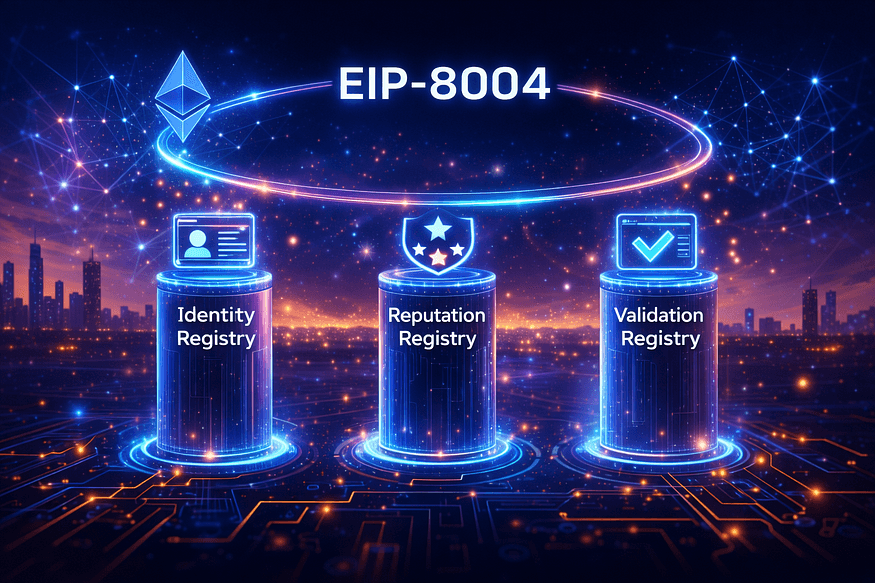
1. Identity Registry — Giving Every Agent a Unique Identity
The Identity Registry assigns each AI agent a verifiable, globally unique identity. Think of it as a passport for AI agents.
This identity is implemented as an NFT built on ERC-721 (with URI storage extension), which means each agent gets a unique, tamper-proof token on the blockchain.
An agent is globally identified by two things:
agentRegistry: identifies where the agent is registered:
namespace: the chain family identifier (e.g.,eip155for EVM chains)chainId: uniquely identifies the chain within the Ethereum ecosystemidentityRegistry: the contract address where the ERC-721 registry is deployed
For example: eip155:1:0x9dfD102194bE9CefE9ea652FBF47ffB8416302D8
agentId: the specific token ID (NFT) assigned to the agent within that registry.
Since storing rich metadata directly on-chain is expensive, the agent’s metadata is hosted off-chain (as a Base64-encoded file or a URL). The on-chain record simply points to it. This hosted file contains the agent’s name, description, image, and service details.
The registry exposes getMetadata and setMetadata functions for reading and updating this information. New agents are minted on-chain by calling the register function.
2. Reputation Registry — Measuring Trustworthiness
Once an agent has an identity, the next question is: how good is it, really?
The Reputation Registry answers that. It aggregates client feedback to produce a trust score for each agent. A higher reputation means more trust and more opportunities.
Each piece of feedback must include:
valueanddecimals: together, these represent the score
Optionally, feedback can also include:
tag1andtag2: developer-defined metadata for categorizing the feedbackA file URL: pointing to an off-chain JSON file with additional context (again, storing rich data on-chain is expensive, so we store just the link)A keccak-256 URL: a cryptographic fingerprint of that JSON file, stored on-chain to detect any tampering
Clients can also revoke their feedback at any time by calling the revokeFeedback function on-chain.
This reputation system works well for most everyday tasks. But what about high-stakes situations where subjective ratings just aren’t enough?
3. Validation Registry — Cryptographic Proof of Capability
If Reputation is subjective, Validation is objective.
The Validation Registry goes a step further; it cryptographically verifies whether an agent actually delivered what it claimed. This is where things get really interesting.
The Validation Registry is a smart contract that stores:
Validation requests and results
Cryptographic proof references
Validator identity
Optional stake or attestation data
There are two key actors:
Subject Agent :the agent that performed the task and produced an output
Validator Agent :an independent agent that verifies the output
Here’s how it works:
Step 1: The Subject Agent produces output. The agent performs its computation or task. The output itself is stored off-chain, but a hash of that output is recorded on-chain. This ensures integrity without breaking the bank on gas costs.
Step 2: The Validator Agent reviews and responds. An independent validator checks the subject agent’s output and submits the result to the Validation Registry on-chain. Validators are incentivized to participate through economic rewards, reputation building, and ecosystem participation.
Putting It All Together
Here’s how the three registries work in practice:
A client searches the Identity Registry to discover agents with the right capabilities.
The client filters those agents using the Reputation Registry, looking for high trust scores and positive feedback.
If the stakes are high enough, the client digs deeper into the Validation Registry to verify that the agent’s claims have been independently confirmed.
Once a suitable agent is selected and the task is completed, the client leaves feedback and the agent’s reputation grows over time.
Over time, an agent builds a portfolio of verifiable work, reputation, and validated claims. It’s a compounding trust flywheel.
Why Blockchain?
You might be wondering: why blockchain? Why not just build a centralized ratings platform?
The short answer is decentralization. With a blockchain-based system:
No single entity controls the network
Identity, reputation, and validation records cannot be secretly modified or manipulated
There is no inherent bias baked into the system by a central authority
The trust is built into the protocol itself, not into whoever runs the server.
Conclusion
ERC-8004 fills a real and growing gap. As AI agents become more autonomous and more capable, the need for a reliable way to discover, evaluate, and trust them becomes critical — especially when money or important decisions are on the line.
By combining an Identity Registry, a Reputation Registry, and a Validation Registry, ERC-8004 gives clients a structured, trustless way to find the right agent for the job. The agent’s claims aren’t just promises; they’re verified, on-chain, and cryptographically sound.
We’re moving from “bet on the agent and hope” to “verify, then trust.” And that’s a meaningful step forward.
Feel free to clap, comment, or follow for more deep dives into Ethereum + AI!